
Suspension, Chassis & Steering Testing Equipment
Vehicle Suspension Performance Tester | CTXX-3/CTXX-10
A faulty damping system compromises directional stability, increases braking distances, and accelerates irregular tire wear. For vehicle inspection stations, fleet depots, and automotive workshops, deploying a verified...

A faulty damping system compromises directional stability, increases braking distances, and accelerates irregular tire wear. For vehicle inspection stations, fleet depots, and automotive workshops, deploying a verified suspension tester ensures that degraded shock absorbers are diagnosed quantitatively before road failure occurs. Operating as dedicated automotive testing equipment, a modern Vehicle Suspension Tester eliminates subjective road assessments by applying resonant mechanical oscillation to determine dynamic road-contact efficiency.
Contents
- Equipment Definition, Operating Principle, and Scope
- Buyer Value and Technical Selection Considerations
- Measurement Methodology and Model Classifications
- Materials, Quality Control, and Standards Compliance
- Procurement Guidelines and Operational Risk Mitigation
- Frequently Asked Questions
- Conclusion
Equipment Definition, Operating Principle, and Scope
A suspension tester is an electro-mechanical diagnostic system engineered to evaluate the damping efficiency and shock absorption capacity of vehicles equipped with independent suspension systems. Designed as a cornerstone of modern diagnostic lanes, this suspension testing equipment identifies internal strut leakage, broken spring rates, and mechanical looseness by recording wheel-to-ground contact forces under dynamic excitation.
The Dynamic Measurement Sequence
The operational cycle of the Cartesykj Vehicle Suspension Tester follows a systematic multi-stage evaluation:
- Static Axle Weighing: The vehicle drives onto the independent test plates. High-precision load sensors record the static wheel load and display the values on the central software monitor.
- Forced Mechanical Excitation: Dual high-power electric motors (2 × 2.2 kW) engage eccentric drive wheels, driving the vibrating plates into vertical oscillation at a frequency of ≥23 Hz with a standard stroke amplitude of 6 mm.
- Motor Cut-Off and Resonant Decay: Upon reaching nominal operational speed, the motors shut down automatically. The vibrating plates continue moving solely through mechanical inertia.
- Sympathetic Resonance Tracking: As the vibration frequency decays through the vehicle wheel-hop natural frequency (typically between 12 Hz and 16 Hz), sympathetic vibration occurs between the tire, unsprung mass, and the chassis.
- Dynamic Minimum Force Extraction: High-speed force transducers continuously track the downward contact force. The system captures the minimum dynamic wheel load experienced during the resonance phase.
The evaluation software calculates the adhesion or absorption rate as a percentage:
Absorption Rate (%) = (Minimum Dynamic Wheel Load / Static Wheel Load) × 100
A higher calculated absorption rate indicates that the damping assembly successfully keeps the tire contact patch firmly planted on the road surface during rapid road surface irregularities.
Material and Application Scope
This diagnostic station accommodates passenger cars, vans, utility vehicles, and transport chassis fitted with independent front or rear suspension geometry. In periodic motor vehicle inspection (PTI) stations, municipal test centers, and high-throughput repair shops, it operates either as a standalone diagnostic bay or integrated into an automated vehicle test lane alongside roller brake testers and sideslip meters.
Buyer Value and Technical Selection Considerations
Specifying testing machinery requires balancing axle load ratings, civil pit dimensions, testing cycle throughput, and diagnostic precision. Cartesykj provides two primary configurations within this model class: the CTXX-3 and the CTXX-10.
Technical Parameter
CTXX-3 Standard Configuration
CTXX-10 Heavy-Pass Configuration
Max. Pass Axle Load (kg)
4,000
10,000
Max. Test Axle Load (kg)
3,000
3,000
Vibration Frequency (Hz)
≥23
≥23
Oscillation Amplitude (mm)
6
6
Motor Power Rating (kW)
2 × 2.2
2 × 2.2
Repeatability Deviation
≤2%
≤2%
Axle Weight Indication Error
≤2%
≤2%
Applicable Tread Width (mm)
800 to 2,200
800 to 2,700
Power Supply Requirements
AC 380V, 50 Hz
AC 380V, 50 Hz
Base Unit Dimensions (mm)
2,400 × 440 × 335
Specific to extended frame
Operational Decision Criteria
Selecting between the CTXX-3 and CTXX-10 depends primarily on the traffic profile passing over the diagnostic floor:
- Dedicated Light Vehicle Lanes: The CTXX-3 handles a maximum drive-over passage load of 4,000 kg and an active dynamic testing load of up to 3,000 kg. With a usable tread width span of 800 mm to 2,200 mm, it accommodates compact sedans, sports cars, SUVs, and light utility vans.
- Mixed-Traffic Shared Lanes: When light-duty suspension testing must be conducted within a commercial lane where heavy trucks or transit buses roll across the test plates, the CTXX-10 is the appropriate choice. Its structural base frame withstands a drive-over axle load of 10,000 kg, while maintaining an active testing load limit of 3,000 kg and an expanded track width span of 800 mm to 2,700 mm.
Measurement Methodology and Classification
Suspension evaluation in automotive service equipment centers around dynamic resonance analysis. Rather than relying on simple static deflection or visual damper fluid inspection, the equipment analyzes physical contact behavior under controlled stress.
The EUSAMA Diagnostic Standard
The European Shock Absorber Manufacturer Association (EUSAMA) methodology serves as the technical baseline for the Cartesykj tester. By oscillating the wheel assembly past its resonant threshold and measuring residual vertical contact force during deceleration, the system evaluates how effectively the damper counters unsprung wheel hop. Because road safety depends on tire-road contact during braking and cornering maneuvers, the minimum dynamic vertical force recorded during resonance provides an objective safety metric.
Visual Damping Curve Analysis
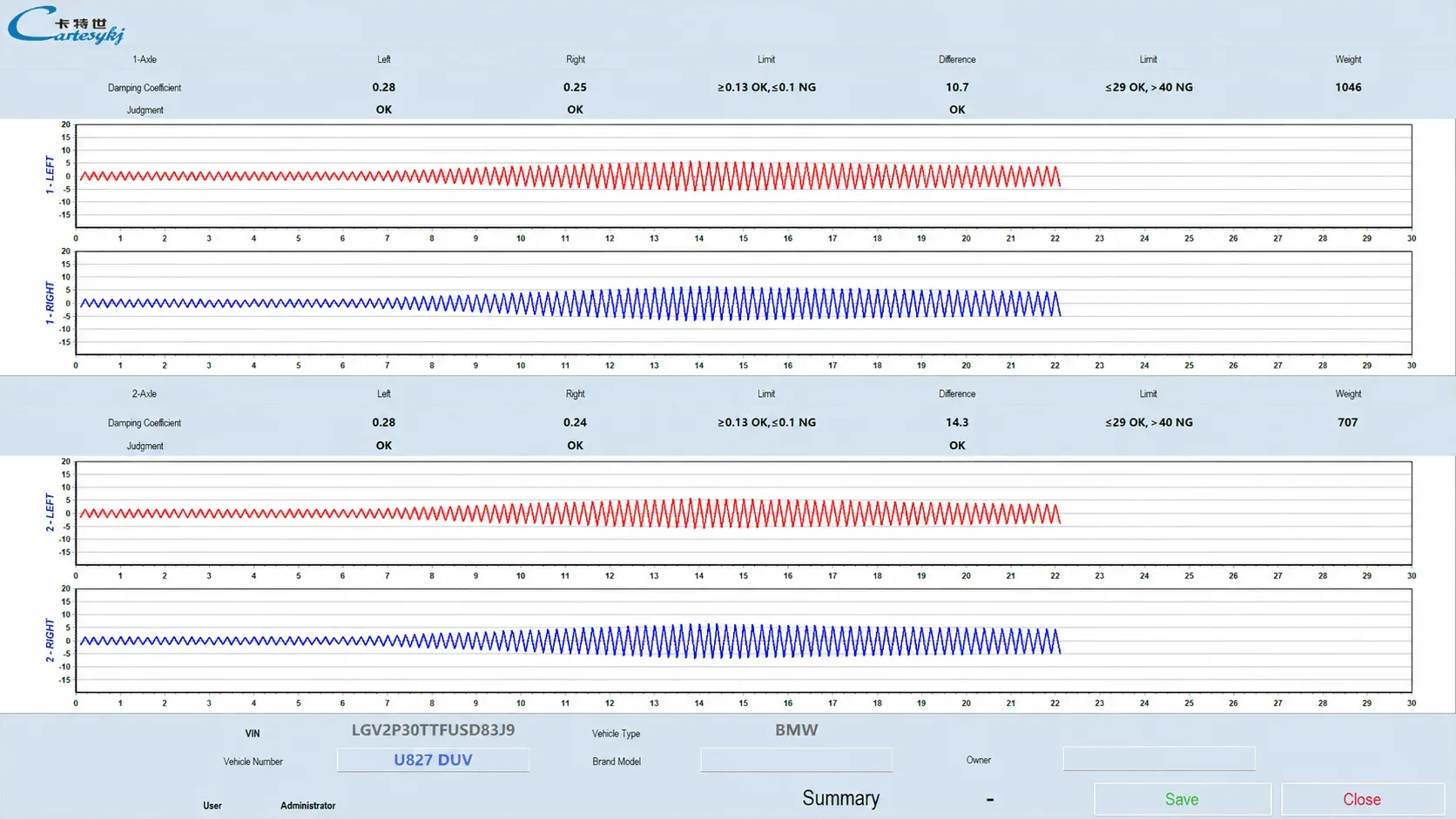
Modern service operations require clear diagnostic readouts for customer communication. The tester interface renders real-time graphical frequency and force curves. Operators and vehicle owners can visually compare left-to-right wheel symmetry and evaluate suspension response before and after strut replacement or suspension maintenance.
Materials, Quality Control, and Standards Compliance
The durability of floor-recessed testing hardware depends directly on corrosion resistance, drive-train rigidity, and sensor stability under sustained workshop traffic.
Structural Design and Anti-Corrosion Protection
The platform surfaces utilize heavy-duty galvanized steel plates, protecting the equipment from water, de-icing salts, and debris carried into the inspection bay by vehicle tires. The chassis frame is manufactured using integral high-strength welding to resist torsional deformation caused by steering maneuvers and repeated vehicle passage.
Vibration Attenuation and Drive Systems
To prevent mechanical noise from contaminating sensor signals, the tester incorporates a low-noise structure design. Imported damping shock absorbers isolate the base frame from surrounding pit concrete, minimizing false vibration readings. Power delivery is managed by dual 2.2 kW motors driving precision eccentric cams to ensure consistent initial vibration frequency (≥23 Hz) without motor stall.
Sensor Accuracy and Industry Benchmarks
The internal measurement assembly utilizes industrial high-precision load cells and displacement sensors, delivering an axle weight indication deviation of ≤2% and an absorption rate repeatability deviation of ≤2%. The equipment complies fully with the Chinese transport industry standard JT/T448-2001 for automotive suspension test benches and conforms to the EUSAMA measurement standard.
Procurement Guidelines and Operational Risk Mitigation
Investing in heavy-duty inspection machinery requires careful planning around electrical infrastructure, foundation engineering, and long-term maintenance.
Facility Pre-Installation Requirements
- Foundation Pit Preparation: Confirm pit dimensions (2,400 mm × 440 mm × 335 mm for standard CTXX-3 assemblies) with true horizontal leveling across both test sides to eliminate false static weight distribution readings.
- Electrical Supply: Ensure a stable three-phase AC 380V, 50 Hz power drop is installed with dedicated circuit protection to handle dual-motor inrush current.
- Drainage and Cable Conduits: Ensure the recess pit includes clear conduit passages for signal lines and an integrated gravity drain or sump point to keep moisture away from load cells and drive components.
Ongoing Maintenance and Calibration Routine
To preserve diagnostic accuracy within the ≤2% deviation threshold, facilities should institute routine maintenance checks:
- Weekly Bay Cleaning: Clear loose grit, gravel, and standing water from the gaps surrounding the vibrating plates to prevent mechanical binding.
- Monthly Structural Inspection: Check the integral welded frame, foundation anchor bolts, and eccentric drive linkages for hardware tightness and proper lubrication.
- Sensor Re-Calibration: Verify static weighing accuracy at planned intervals using calibrated test weights in accordance with JT/T448-2001 and local inspection mandates.
Frequently Asked Questions
How does the suspension tester calculate the absorption rate?
The vehicle sits on the vibrating plates to record static wheel load. Electric motors drive the plates to an oscillation frequency of ≥23 Hz and then shut down. As the plates decelerate through natural resonance, the system measures the minimum dynamic vertical force. The absorption rate is calculated as the ratio of this minimum dynamic load to the static load, expressed as a percentage.
What is the primary difference between the CTXX-3 and CTXX-10 models?
Both models evaluate axle test loads up to 3,000 kg at ≥23 Hz vibration frequency. However, the CTXX-3 features a maximum drive-over passage axle load of 4,000 kg with an 800–2,200 mm tread width, whereas the heavy-duty CTXX-10 supports a drive-over pass load of up to 10,000 kg and accommodates wider tread widths up to 2,700 mm.
Which industry standards govern this suspension testing equipment?
The Cartesykj Vehicle Suspension Tester series operates according to the internationally recognized EUSAMA measurement standard and satisfies the technical performance requirements of standard JT/T448-2001 for automotive suspension inspection benches.
What electrical and site requirements are needed for installation?
The standard equipment operates on a three-phase AC 380V, 50 Hz power supply running two 2.2 kW drive motors. It requires a dedicated concrete pit matching the equipment frame footprint, equipped with proper conduit routing and floor drainage.
Conclusion
Implementing an objective, high-precision suspension tester allows vehicle test centers and fleet maintenance facilities to deliver defensible suspension safety diagnostics based on proven EUSAMA dynamic resonance standards. By evaluating parameters such as drive-over axle load capacity, structural galvanization, and measurement repeatability, technical buyers can select the optimal configuration for their facility. Contact our technical engineering team for certified pit drawing specifications, foundation layout guidance, or customized test lane integration support.
Related Products
Compare related inspection systems
Suspension, Chassis & Steering Testing Equipment
Automotive shock absorption and damping tester | CTZN-3
View Product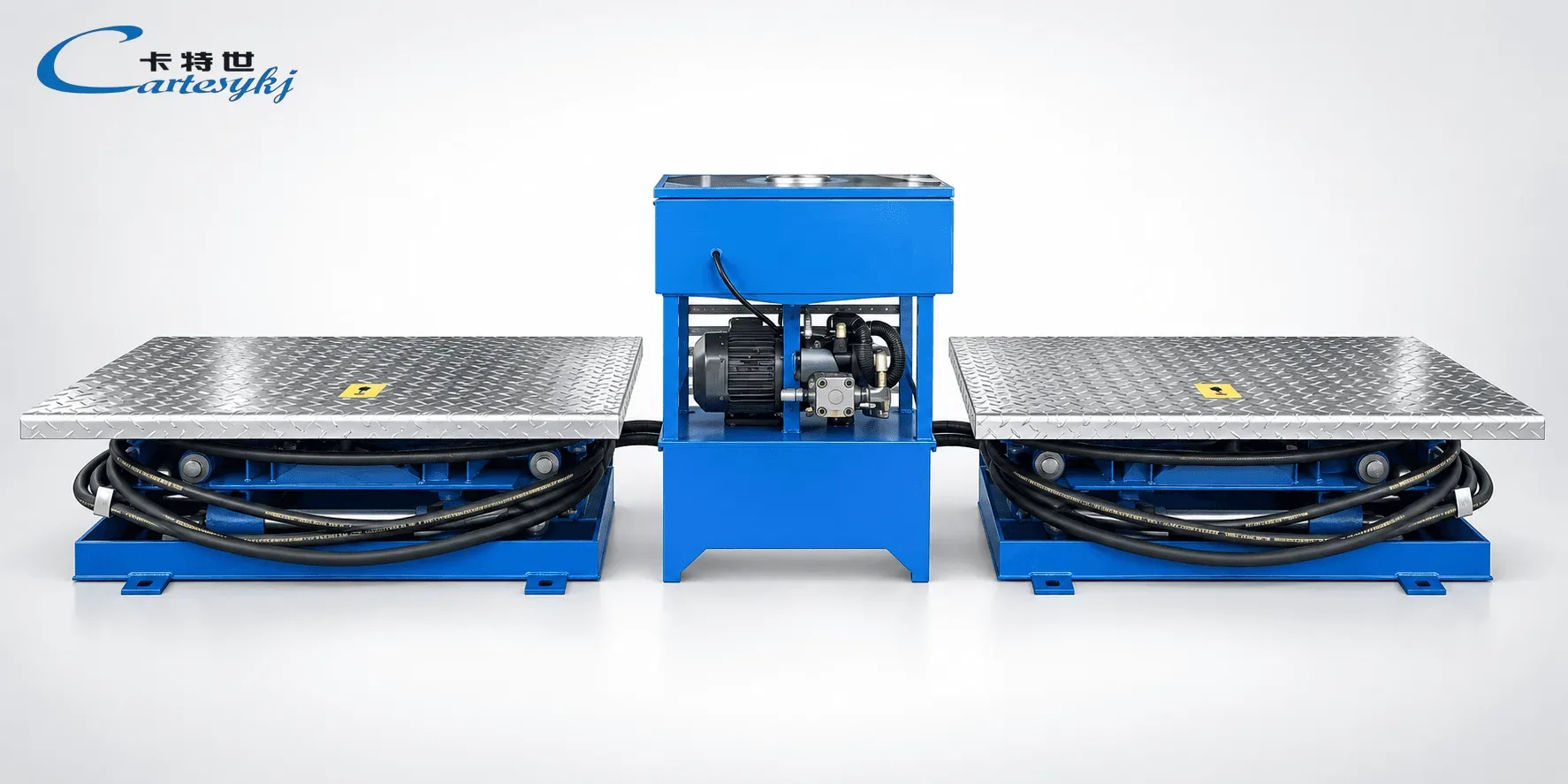
Request a Quote
Request configuration and pricing for your project.
Share your vehicle type, inspection lane layout, target capacity, and required model configuration for Vehicle Suspension Performance Tester | CTXX-3/CTXX-10.
Share the project location, vehicle types, inspection scope, applicable standards, target throughput, site conditions and current stage. We will confirm the configuration scope before discussing pricing.