
Brake & Axle Load Testing Equipment
Vehicle Kerb Mass Tester | CTZZ-15-4
Reliable Vehicle Kerb Mass Tester serves as an operational cornerstone in contemporary vehicle testing facilities, fleet maintenance depots, and regulatory verification stations. When chassis curb mass, total vehicle ma...


Reliable Vehicle Kerb Mass Tester serves as an operational cornerstone in contemporary vehicle testing facilities, fleet maintenance depots, and regulatory verification stations. When chassis curb mass, total vehicle mass, or axle weight distributions deviate from manufacturer specifications, dynamic calculations for kinetic energy dissipation, brake force ratios, and chassis stability become compromised. Integrating an industrial Vehicle Kerb Mass Tester removes operational guesswork by capturing true static contact loads directly at the tire-to-deck interface.
As vehicle engineering advances, transport authorities and commercial fleet managers require precise diagnostic data to enforce vehicle safety, detect unapproved structural modifications, and safeguard roadway infrastructure. A specialized Wheel Load Tester records static forces across individual contact patches, providing the foundational metrics needed to evaluate axle-by-axle balance and dynamic brake performance. Without accurate curb weight data, safety evaluations risk approving overloaded or misaligned chassis.
This technical product review examines the configuration, structural characteristics, and station integration of multi-axis weight assessment machinery. Specifically, this analysis covers the Cartesykj CTZZ-15-4 multi-axis curb weight bench, detailing how this multi-plate setup streamlines heavy multi-axle testing while complying with established technical standards.
Table of Contents
- Equipment Definition and Material/Application Scope for Vehicle Kerb Mass Tester
- Buyer Value and Sourcing Considerations for Vehicle Kerb Mass Tester Systems
- Verified Technology Trends and Classifications in Vehicle Kerb Mass Tester
- Documented Materials, Quality Controls, Certifications, and Components
- Practical Sourcing and Risk-Mitigation Guidance for Testing Facilities
- Frequently Asked Questions About Vehicle Kerb Mass Tester Equipment
- Conclusion
1. Equipment Definition and Material/Application Scope for Vehicle Kerb Mass Tester
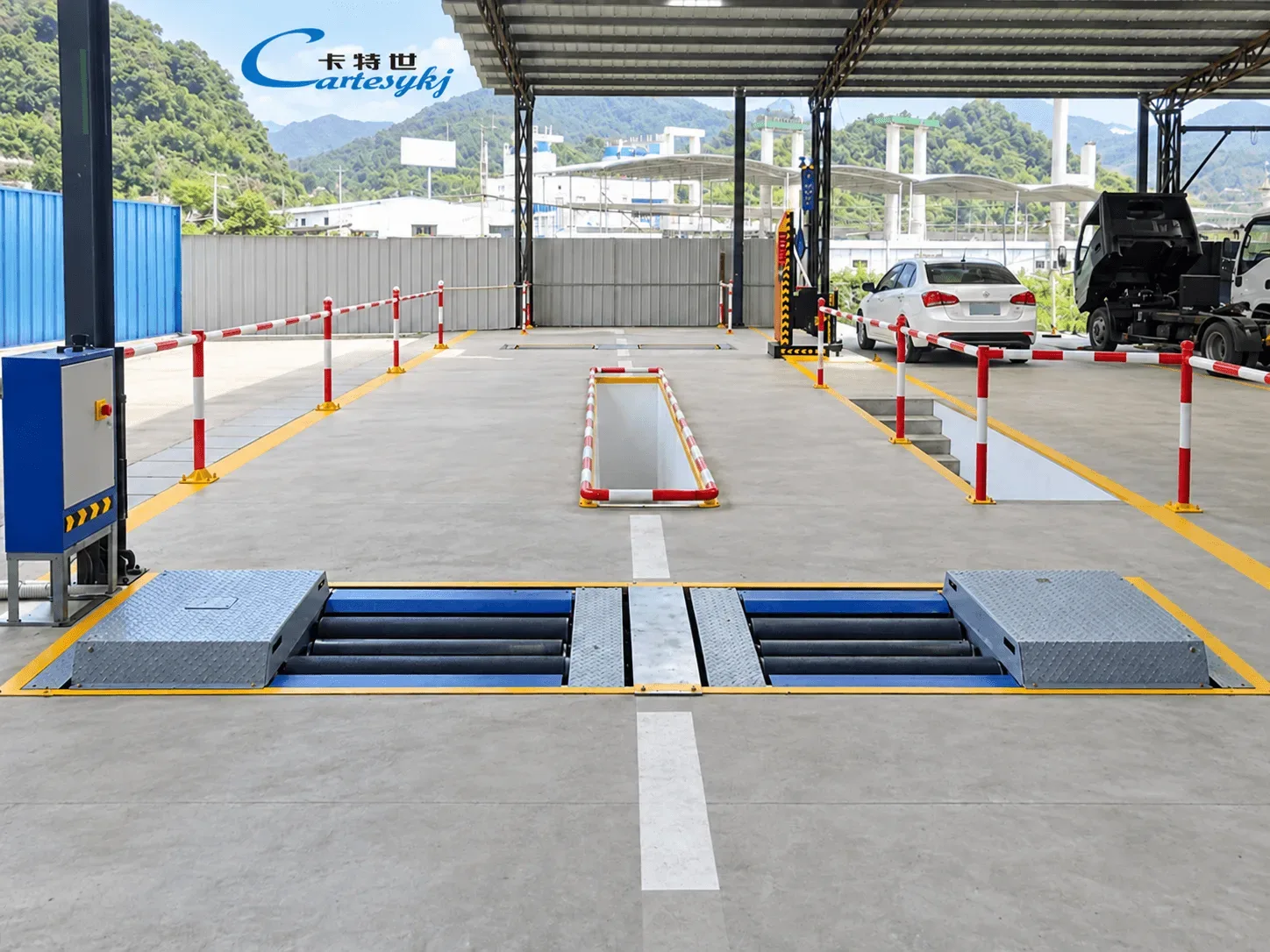
Within official testing lane architecture, equipment dedicated to Vehicle Kerb Mass Tester operates as an electro-mechanical system designed to measure total curb mass alongside individual axle and wheel loads. The physical assembly comprises two primary structural groups: the multi-axis wheel load testing bench and the operational system hardware managing high-speed signal acquisition, filtering, and data communication.
Installed directly within an active Inspection Line, the testing bench measures total static vehicle mass, individual axle mass, and independent wheel loads. These readings form the empirical baseline for vehicle curb weight verification and brake force ratio calculations under regulatory evaluation protocols.
The Cartesykj CTZZ-15-4 is engineered specifically as a multi-axis vehicle axle and wheel load tester. It resolves a long-standing engineering challenge encountered when testing commercial transport vehicles equipped with tandem or tridem axle sets. On conventional short-deck scales, adjacent suspension equalizers transfer dynamic loads between axles during incremental vehicle repositioning, which compromises measurement accuracy. The CTZZ-15-4 addresses this challenge by allowing dual-axis or tri-axis side-by-side wheels on the same side of the vehicle to rest simultaneously on a single weighing plate structure during assessment.
The practical application scope for this high-capacity testing bench covers a diverse range of operational automotive and commercial testing environments:
- Statutory Vehicle Inspection Stations: Conducting standardized periodic Vehicle Kerb Mass Tester routines to confirm vehicle curb mass matches regulatory registration data.
- Commercial Transport Depots and Fleet Service Stations: Measuring static wheel load distribution across suspension linkages prior to running high-speed dynamic brake tests.
- Specialized Vehicle Manufacturing and Body Modification Plants: Verifying curb mass and lateral balance after mounting superstructures, hydraulic accessories, refrigeration assemblies, or heavy vocational bodies.
- Heavy Commercial Repair Workshops: Diagnosing asymmetric suspension settlement or structural torsion following extensive structural repairs or axle rebuilds.
Engineering Parameter
Measurement Unit
Cartesykj CTZZ-15-4 Technical Value
Axle Load Capacity
kg
3 × 10,000
Weighing Plate Dimensions (Deck Size)
mm
2 × 4,000 × 1,150
Vehicle Wheel Track Operating Range
mm
700 (Inner Minimum) / 3,000 (Outer Maximum)
Regulatory Standard Compliance
Standard Code
GB21861 Standard
2. Buyer Value and Sourcing Considerations for Vehicle Kerb Mass Tester Systems
For technical directors, lane designers, and procurement managers, selecting hardware for Vehicle Kerb Mass Tester demands a balance between throughput speed, structural reliability, and measurement accuracy. Incorporating a dedicated multi-axis platform into a high-volume testing station eliminates the operational delays caused by repetitive multi-stop positioning sequences.
When multi-axle freight trucks or commercial buses pass over conventional single-axle scale plates, the vehicle must stop, stabilize, record data, and pull forward for each axle. This repetitive staging introduces measurable operational inefficiencies:
- Mechanical Suspension Load Shifting: Frequent braking and incremental pull-ahead movements flex mechanical leaf springs or alter air suspension leveling valves, skewing static wheel load data.
- Cumulative Lane Bottlenecks: Repositioning multi-axle vehicles several times extends inspection cycle times per chassis, creating costly vehicle queues during peak operational hours.
- Accelerated Mechanical Wear: Repetitive dynamic stops on short scale decks subject load cell mounts and pit edge angles to sharp lateral shear forces.
The CTZZ-15-4 eliminates these concerns through its generous 2 × 4,000 × 1,150 mm weighing plate platform. Boasting a robust axle load capacity of 3 × 10,000 kg (representing 30 metric tons across tandem or tridem configurations), multi-axis commercial assemblies can roll onto the deck and settle in a single step. The spacious four-meter deck length accommodates multi-axle groups completely, ensuring every wheel load is recorded simultaneously under static, settled conditions.
Furthermore, the broad wheel track range spanning from 700 mm at the inner edge to 3,000 mm at the outer boundary provides exceptional testing versatility. A single testing lane can evaluate compact light commercial vehicles, standard municipal transit buses, wide-stance specialized trailers, and heavy freight trucks without requiring mechanical adjustments or secondary lanes.
3. Verified Technology Trends and Classifications in Vehicle Kerb Mass Tester
Automotive testing stations categorize weighing equipment based on deck architecture, axle capture methods, and sensor mounting layouts. Understanding these technical classifications allows facility planners to specify equipment that matches their operational throughput and space constraints.
Design Parameter
Single-Axle Static Scales
Multi-Axis Tandem Systems (CTZZ-15-4)
Deck Plate Length
Short deck profile (typically < 1,000 mm)
Extended dual plates (2 × 4,000 × 1,150 mm)
Tandem Axle Handling
Axle-by-axle sequential measurement
Simultaneous dual-axis and tri-axis measurement
Track Width Versatility
Narrow operational band (800–2,200 mm)
Wide envelope (700 mm inner to 3,000 mm outer)
Suspension Interaction
Inter-axle load transfer causes errors
Full tandem group measured statically on one deck
Sensor Mounting Layout
Standard pit base plate mounting
Configurable pit-side sensor mounting option
A notable trend in testing station design is the shift toward side-mounted load sensor arrays within inspection pits. In conventional configurations, load cells are mounted directly beneath the center of the scale plate, complicating physical access during maintenance. The CTZZ-15-4 supports an optional mounting configuration where sensors install along both outer sides of the pit trench. This design leaves the central pit area clear for underside vehicle inspections while positioning sensors in accessible side recesses for fast service and routine inspection.
Modern testing benches also utilize robust digital signal conditioning. Analog voltages generated by tire downward pressure are quickly digitized, filtered to remove ambient facility vibrations, and transmitted directly to the central diagnostic processor. This electronic architecture maintains signal integrity, ensuring that each Vehicle Kerb Mass Tester yields clean, repeatable metrics under fluctuating ambient conditions.
4. Documented Materials, Quality Controls, Certifications, and Components
The structural reliability of any Vehicle Kerb Mass Tester system relies on the rigidity of its steel platform and the performance of its internal sensors. Scale decks subject to excessive mechanical deflection under concentrated wheel loads can introduce parasitic side forces into the load cells, resulting in non-linear measurement drift.
The Cartesykj CTZZ-15-4 uses premium high-precision sensors engineered to maintain structural linearity and deliver dependable repeatability under heavy load conditions. These precision sensors detect minute weight differences across lateral wheel pairs. Accurately capturing left-to-right wheel load differentials is essential for diagnosing uneven suspension wear and providing accurate axle weight values for dynamic brake efficiency calculations.
Regulatory certification is essential when selecting testing equipment. The CTZZ-15-4 is engineered to meet the operational criteria of the GB21861 automotive inspection standard. This standard governs periodic technical inspections for motor vehicles, setting rigorous tolerances for measuring vehicle curb mass and axle loads. Aligning with GB21861 ensures that test results generated by the CTZZ-15-4 integrate seamlessly into statutory roadworthiness databases, vehicle registration platforms, and national transport compliance records.
5. Practical Sourcing and Risk-Mitigation Guidance for Testing Facilities
Procuring specialized testing machinery from a professional Vehicle Inspection Equipment Manufacture requires thorough planning across civil engineering, software integration, and structural duty requirements. Testing station operators can minimize project risks by evaluating the following technical factors:
- Foundation Pit Construction: A 4,000 mm multi-axis weighing platform exerts substantial point loads across its foundation contact pads. Civil pits must feature reinforced, level concrete pads and proper drainage channels to prevent water accumulation around the lower frames. Utilizing pit-side sensor mounting options keeps primary measurement hardware accessible for routine maintenance without requiring deck plate removal.
- Operational Fleet Track Verification: Confirm that the platform's working width accommodates the entire fleet profile. With its 700 mm inner and 3,000 mm outer wheel track coverage, the CTZZ-15-4 handles passenger cars, light commercial vans, broad municipal coaches, and heavy commercial vehicles on a single testing line.
- Structural Safety Capacities: Review maximum axle loading ratings against dynamic entry forces. The CTZZ-15-4 features a rated capacity of 3 × 10,000 kg, providing a dependable safety margin when testing heavy multi-axle freight vehicles operating at maximum legal axle limits.
- Periodic Calibration Protocols: Implement structured calibration routines using certified static reference weights to verify that load cells across both plates maintain consistent linear responses across the entire measurement range.
- Brake Tester Data Handshake: Ensure static wheel load values interface directly with roller brake testing software. Accurate wheel load data is critical for calculating precise brake efficiency percentages.
By assessing these technical criteria prior to site preparation, procurement teams can implement an efficient, compliant weighing lane that ensures reliable operation over years of high-volume testing.
Frequently Asked Questions About Vehicle Kerb Mass Tester Equipment
What is the core function of a Wheel Load Tester in a vehicle testing station?
A Wheel Load Tester measures the individual downward static force applied by each vehicle tire on the scale deck. This granular data allows inspection stations to detect uneven lateral load distributions, verify baseline vehicle curb mass against official specifications, and provide accurate axle load values for dynamic brake efficiency calculations during a standard Vehicle Kerb Mass Tester.
How does the CTZZ-15-4 handle multi-axis commercial vehicles?
The CTZZ-15-4 features extended weighing plates measuring 2 × 4,000 × 1,150 mm. This large surface area allows dual-axis and tri-axis tandem wheel groups on the same side of the vehicle to stand simultaneously on a single weighing platform. This design eliminates the measurement errors and mechanical load shifting commonly encountered on short single-axle scales.
Can the sensors on the CTZZ-15-4 be configured for standard inspection pits?
Yes. The hardware is designed for flexible installation, allowing measurement sensors to be mounted along both sides of an inspection pit. This pit-side arrangement provides convenient access for maintenance and calibration while keeping the center trench clear for lower-body chassis inspections.
Which regulatory standard governs this curb weight measurement platform?
The CTZZ-15-4 is engineered to meet the operational criteria of the GB21861 standard. This national standard sets testing methods and compliance tolerances for motor vehicle safety inspections, including baseline curb mass verification.
Why is static wheel load data essential for dynamic brake force testing?
Brake efficiency percentages are calculated by comparing dynamic braking forces directly against measured static axle loads. If the static axle load is inaccurate or shifted by suspension equalizers, the resulting brake ratio calculation will be flawed. Precise static weight acquisition ensures accurate vehicle safety evaluations.
Conclusion
Executing an accurate Vehicle Kerb Mass Tester is essential for identifying overloaded commercial vehicles, maintaining road infrastructure, and verifying braking performance. The Cartesykj CTZZ-15-4 multi-axis wheel load testing bench combines a high-capacity 3 × 10,000 kg axle rating, an expansive 4,000 mm plate length, and flexible pit-side sensor mounting to meet the demanding requirements of commercial vehicle testing lines. To review foundation layout specifications, obtain technical dimensional drawings, or discuss testing lane integration, contact our technical engineering team for dedicated project support.
Related Products
Compare related inspection systems
Brake & Axle Load Testing Equipment
Roller Brake Tester With Axle Load | CTFZ-3B/CTFZ-10B/CTFZ-13B
View Product
Brake & Axle Load Testing Equipment
Vehicle Axle (Wheel) Load Tester | CTZZ-3/CTZZ-10/CTZZ-15
View ProductRequest a Quote
Request configuration and pricing for your project.
Share your vehicle type, inspection lane layout, target capacity, and required model configuration for Vehicle Kerb Mass Tester | CTZZ-15-4.
Share the project location, vehicle types, inspection scope, applicable standards, target throughput, site conditions and current stage. We will confirm the configuration scope before discussing pricing.