
Insights
Vehicle Inspection Equipment: Types, Systems, and Selection Criteria for Modern Test Lanes
A technical guide to vehicle inspection equipment: brake tester, suspension tester, sideslip tester, play detector, and speedometer tester systems, with model parameters, vehicle-category guidance, and sourcing criteria.
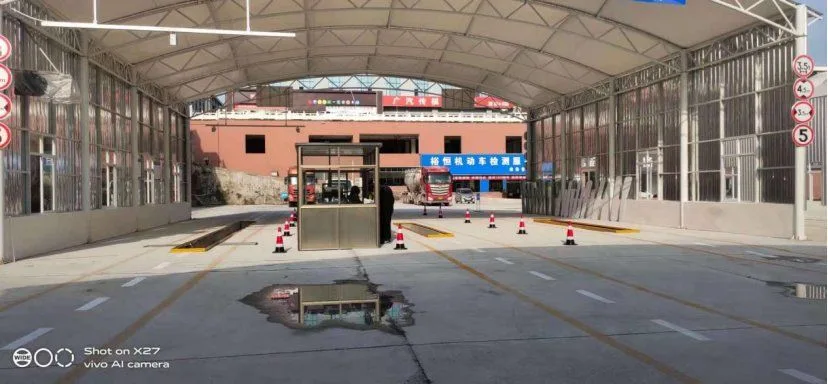
A roadworthiness decision is a zero-tolerance checkpoint. When a test lane misreads braking imbalance, lateral scrub, or degraded damping, an unsafe vehicle returns to public roads and the inspection facility absorbs the compliance, liability, and reputational cost. Professional vehicle inspection equipment replaces subjective road judgment with measured, repeatable, and defensible data captured under controlled conditions. Modern inspection centers face two simultaneous pressures: statutory tolerances that leave no room for borderline miscalculation, and throughput targets that punish slow manual procedures. Building a capable lane therefore means matching the right instrument to the right vehicle class, then integrating those instruments into a single controlled test sequence. Cartesykj manufactures the full core bench range—brake tester, suspension tester, sideslip tester, play detector, and speedometer tester platforms—for passenger cars, commercial trucks, motorcycles, and mixed-traffic facilities. This guide breaks down what each category measures, how systems are configured by vehicle class and installation model, and which technical criteria separate a reliable purchase from an expensive retrofit. All parameters below are drawn from documented factory specifications, including model ratings, supply requirements, and application envelopes.
Table of Contents
- Importance of Professional Vehicle Inspection
- Core Components of Modern Inspection Systems
- Role of AI and Automation in Diagnostics
- Brake, Suspension, and Sideslip Testers
- Emissions Analyzers and Smoke Meters
- Headlight Testers and Visibility Tools
- On-Board Diagnostics (OBD) and Mobile Inspection Kits
- Light Vehicle (LV) and Passenger Car Test Lanes
- Heavy-Duty Vehicle (HDV) and Truck Inspection Lines
- Motorcycle and L-Category Inspection Equipment
- Fixed Annual Vehicle Inspection Stations
- Containerized and Mobile Test Lanes
- Remote Sensing Devices (RSD) for Roadside Testing
- Ensuring Regulatory Compliance and Certification
- Compatibility Across Diverse Vehicle Models
- Evaluating Technical Support, Software, and Spare Parts
- Frequently Asked Questions
- Engineering Consultation and Quotation
Overview of Vehicle Inspection Equipment
Importance of Professional Vehicle Inspection
Periodic technical inspection exists to catch failures before they become road incidents. Brake imbalance, worn steering linkages, degraded shock absorbers, and inaccurate speedometers rarely announce themselves clearly to a driver; they surface as directional pull, extended stopping distance, uneven tire wear, or an instrument reading that drifts from true road speed. Instrumented testing exposes each condition while the vehicle is still in a controlled bay. For facility operators, the value is threefold. First, measured results create a permanent record that withstands audit and dispute—peak braking force, process deviation, axle load, and side-slip displacement are logged rather than estimated. Second, consistent data protects the lane from borderline misclassification: a brake tester recording sub-1.5% measurement error, for example, gives far more defensible pass/fail decisions than a tolerance of 3.0%. Third, quantitative diagnostics let fleet depots schedule maintenance on condition rather than on calendar, reducing unplanned roadside out-of-service events. The consequence of skipping these checks is not abstract. Undetected play in tie rods and ball joints produces instability and uneven tire wear; a damper operating below effective absorption rate lengthens braking distance because the tire loses road contact over surface irregularities; a slow brake caliper on one side creates asymmetric torque under emergency stopping. Each is a measurable parameter before it is an accident.
Core Components of Modern Inspection Systems
A complete lane is a set of discrete benches that together cover the safety-critical subsystems of the vehicle. The core configuration normally includes:
- Brake tester — measures left and right wheel braking force, dynamic axle load, process deviation, and peak force deviation; optionally pedal effort and coordination curves. Cartesykj CTFZ roller platforms operate at a standardized 2.5 km/h detection speed across 3,000–15,000 kg axle classes.
- Suspension tester — applies resonant vertical excitation and computes an absorption rate from minimum dynamic wheel load versus static load. Cartesykj suspension tester platforms oscillate at ≥23 Hz with 6 mm amplitude and follow the EUSAMA methodology.
- Sideslip tester — records lateral displacement of a floating plate as the steered axle crosses it, expressed in m/km. CTCH platforms use a ±15 m/km measuring range with linked, independent, or single-plate kinematics.
- Play detector — applies hydraulic longitudinal and lateral plate movement under vehicle weight to expose clearance in tie rods, ball joints, steering arms, wheel bearings, and suspension bushings. CTJX play detectors deliver 20 kN displacement force at 60–80 mm/s.
- Speedometer tester — compares dashboard indication against roller surface speed over 0–130 km/h. CTCS speedometer testers use non-contact velocity sensing and pneumatic airbag access.
- Supporting stations — axle load and kerb mass measurement, emissions and smoke analysis, headlight beam testing, chassis and tread scanning, plus lane control hardware that brings each reading into one report.
The integration layer matters as much as the benches. Instrument control consoles suit independent workshops; industrial cabinet control transmits data directly into lane software alongside brake and suspension results. Without that shared data path, operators key values by hand and the throughput advantage of automated benches disappears.
Role of AI and Automation in Diagnostics
Automation in inspection is best understood as three concrete capabilities rather than a marketing label. The first is automated sequencing: pneumatic lifting, motor cut-off at defined thresholds, and speed interlocks remove manual timing from the test. A speedometer bench that locks its lifting mechanism once roller speed exceeds 5 km/h, or a suspension bench that cuts drive motors at nominal oscillation speed and lets resonance decay naturally, is executing a controlled procedure that a human cannot reproduce identically each cycle. The second is sensor-driven repeatability. High-precision load cells, non-contact velocity pickups, and synchronized plate kinematics produce numerical outputs with stated deviation bands—≤2% repeatability on suspension measurement, synchronization error below 0.04 mm on linked side-slip plates. These numbers are what make trend comparison between inspections possible. The third is data interpretation support. Lane software now captures force curves, displacement direction, and pass/fail thresholds, and can flag drift across repeated visits. This is diagnostic decision support: it highlights that a left-side brake force has been trending down over three inspections, or that side-slip direction reversed after alignment work. It does not replace the regulated acceptance decision, which remains governed by local inspection mandates and the equipment's documented tolerances. Buyers should treat claims of autonomous diagnosis skeptically and ask instead for the measurable repeatability, calibration method, and reporting format behind the software.
Types of Vehicle Inspection Equipment
Brake, Suspension, and Sideslip Testers
These three benches address the dynamic safety behaviors that cannot be judged statically, and they are the most common core of any inspection lane. A brake tester in the Cartesykj CTFZ series measures braking force per axle alongside dynamic wheel load. Integrating load sensors into the roller frame produces a combined brake-and-axle-load bench, eliminating a separate scale and its bay footprint. Process deviation tracking reveals asymmetric force build-up before peak force is reached—pinpointing sticking guide pins or unequal hydraulic pressure. Automatic stop devices halt roller rotation on wheel slip to prevent tire scuffing, available as a mechanical third-roller sensor or software-controlled motor shutdown.
| Brake tester parameter | CTFZ-3B | CTFZ-10B | CTFZ-13B |
|---|---|---|---|
| Maximum axle-load mass | 3,000 kg | 10,000 kg | 15,000 kg |
| Braking force range | 2 × (0–10) kN | 2 × (0–30) kN | 2 × (0–45) kN |
| Detection speed | 2.5 km/h | 2.5 km/h | 2.5 km/h |
| Wheel track (inner / outer) | 700 / 2,400 mm | 700 / 2,700 mm | 700 / 2,900 mm |
| Roller size | Ø245 × 850 mm | Ø245 × 1,000 mm | Ø245 × 1,100 mm |
| Motor power | 2 × 3 kW | 2 × 11 kW | 2 × 15 kW |
| Overall dimensions | 2,900 × 870 × 350 mm | 4,100 × 1,115 × 450 mm | 4,100 × 1,115 × 480 mm |
| A suspension tester evaluates damping by forced oscillation and resonant decay. The vehicle is statically weighed, plates are driven at ≥23 Hz, motors shut off, and the minimum dynamic contact force is captured as frequency passes through wheel-hop resonance. Absorption rate equals minimum dynamic wheel load divided by static wheel load, expressed as a percentage. | |||
| Suspension tester parameter | CTXX-3 | CTXX-10 | |
| --- | --- | --- | |
| Maximum pass axle load | 4,000 kg | 10,000 kg | |
| Maximum test axle load | 3,000 kg | 3,000 kg | |
| Vibration frequency | ≥23 Hz | ≥23 Hz | |
| Oscillation amplitude | 6 mm | 6 mm | |
| Motor power | 2 × 2.2 kW | 2 × 2.2 kW | |
| Repeatability deviation | ≤2% | ≤2% | |
| Applicable tread width | 800–2,200 mm | 800–2,700 mm | |
| Supply | AC 380 V, 50 Hz | AC 380 V, 50 Hz | |
| Base dimensions | 2,400 × 440 × 335 mm | Extended frame | |
| A sideslip tester measures net lateral scrub generated by combined camber and toe angles as the vehicle rolls across a floating plate. It is a high-throughput screening tool, not a substitute for a four-wheel alignment bench: it flags that geometry is wrong, but it cannot isolate caster, kingpin inclination, or individual camber degrees. | |||
| Sideslip tester parameter | CTCH-3 | CTCH-10 | CTCH-15 |
| --- | --- | --- | --- |
| Max permitted axle load | 3,000 kg | 10,000 kg | 15,000 kg |
| Wheel tread (inner / outer) | 700 / 2,400 mm | 700 / 2,700 mm | 700 / 2,900 mm |
| Sliding plate | 500 × 850 mm | 1,000 × 1,000 mm | 1,000 × 1,100 mm |
| Overall dimensions | 2,700 × 660 × 200 mm | 3,000 × 1,420 × 180 mm | 3,000 × 1,420 × 180 mm |
| Measurement range | ±15 m/km | ±15 m/km | ±15 m/km |
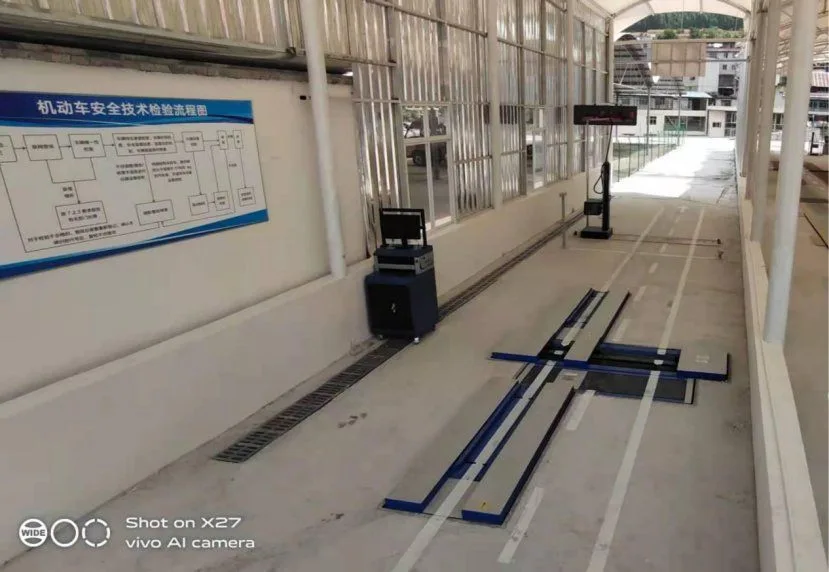
Sideslip tester plates installed in a vehicle inspection lane
Closely related, a play detector applies loaded movement to reveal mechanical clearance that these dynamic benches cannot see directly. The Cartesykj CTJX series uses hydraulic plates with ±50 mm stroke and 20 kN displacement force; the left plate moves fore/aft and laterally, the right plate fore/aft, reproducing multi-axial road stress. CTJX-3 handles 3,000 kg with 760 × 500 mm plates; CTJX-13 handles 13,000 kg with 1,000 × 750 mm plates for wide commercial dual tires. Finally, the speedometer tester closes the instrumentation loop. CTCS-3A, CTCS-10A, and CTCS-15A cover 3,000–15,000 kg axle ratings over 0–130 km/h, using knurled Ø190 mm rollers, pneumatic airbag access at 0.5–0.8 MPa, and a non-contact speed sensor. This is strictly an indication-error bench—not a chassis dynamometer—and does not measure engine torque, horsepower, or road-load simulation.
Emissions Analyzers and Smoke Meters
Emissions stations measure a different failure mode: combustion and aftertreatment condition. A complete setup typically combines exhaust gas analysis for gasoline vehicles with diesel smoke opacity measurement, exhaust flow analysis, and auxiliary calibration instruments. Cartesykj's range covers diesel emission test benches, vehicle exhaust flow analyzers, portable Linelmann blackness meters, tailpipe extraction and treatment systems, conversion-rate verification devices, flow-meter calibrators, and environmental parameter testers. Selection here is driven by the test regime rather than axle load. Buyers should confirm which standard the local authority applies, whether the station must capture opacity or full gas composition, and whether portable instruments are required for roadside or in-service screening. Calibration support matters more than nominal range: a flow analyzer or opacity meter that drifts between annual verification intervals can invalidate an otherwise clean inspection record.
Headlight Testers and Visibility Tools
Headlight testing verifies beam intensity and aim so that a vehicle illuminates the road without dazzling oncoming traffic. A tester measures the beam pattern against a calibrated screen or sensor array; a separate calibrator checks the tester itself. Cartesykj supplies both headlight testing instruments and headlight tester calibrators, along with retroreflection measurement devices used for visibility-related checks. These units are compact but position-sensitive. Facility planners should allocate a level, vibration-free bay with controlled ambient light and a defined vehicle-to-screen distance. Because the instrument itself is the reference, a documented recalibration interval is part of the purchase decision—not an optional extra.
On-Board Diagnostics (OBD) and Mobile Inspection Kits
OBD and mobile tooling extend inspection beyond the fixed bay. On-board diagnostic readers interrogate vehicle fault codes and readiness monitors; PDA-based appearance inspection systems let technicians capture visual checks and attach results to the same vehicle record. Mobile inspection kits become valuable where vehicles cannot be brought to a permanent lane—fleet yards, dealerships, motorcycle service networks, and roadside enforcement points. Cartesykj's mobile product line includes mobile test stations for cars and trucks (CTYJ-10), passenger-car-only configurations (CTMBGT-3-4P), motorcycle stations (CTMYJ-750B / CTMYJ-300B), and combined three-in-one and four-in-one setups, plus a 10 t mobile brake testing unit. A mobile kit normally bundles a brake tester and axle load function, with optional suspension, side-slip, and speedometer modules depending on the configuration. The trade-off is explicit: mobile systems sacrifice some throughput and environmental control in exchange for deployment flexibility, so they should be specified against daily vehicle volume rather than treated as a direct replacement for a permanent lane.
Vehicle Inspection Solutions by Vehicle Category
Light Vehicle (LV) and Passenger Car Test Lanes
Passenger car and light commercial lanes prioritize fast drive-over cycles and compact pit footprints. The 3,000 kg class is the standard starting point: CTFZ-3B brake tester, CTCH-3 sideslip tester, CTXX-3 suspension tester, CTCS-3A speedometer tester, and CTJX-3 play detector form a coherent light-vehicle set. At this class, wheel track compatibility is the practical constraint. Inner track starts at 700 mm on brake and side-slip platforms and 800 mm on the suspension tester; outer limits reach 2,200–2,400 mm. That envelope covers sedans, SUVs, and light vans. Because axle loads are modest, pit excavation is shallower—the CTCH-3 frame is 200 mm high, and the CTFZ-3B sits at 350 mm—making retrofit into existing workshops realistic.
Heavy-Duty Vehicle (HDV) and Truck Inspection Lines
Commercial lanes are defined by axle rating and structural rigidity. Multi-axle freight vehicles and transit buses demand 10,000–15,000 kg capacity: CTFZ-10B or CTFZ-13B brake tester, CTCH-10 or CTCH-15 sideslip tester, CTCS-10A or CTCS-15A speedometer tester, and CTJX-13 play detector with its 13,000 kg rating.
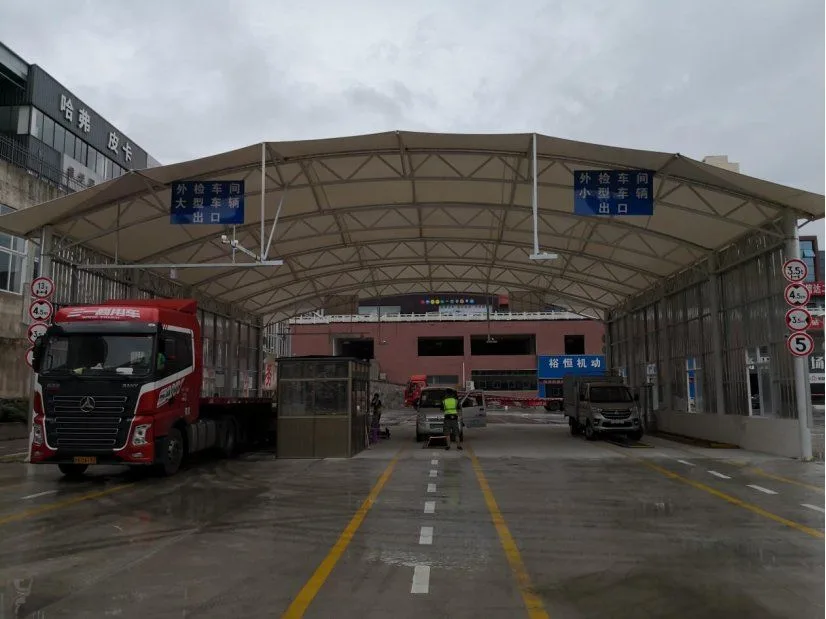
Heavy-duty trucks and passenger cars in a covered inspection station
Two details routinely cause specification errors. The first is confusing drive-over capacity with active test load. The CTXX-10 suspension tester, for example, withstands a 10,000 kg passage axle load but limits active dynamic testing to 3,000 kg—a mixed lane must respect the latter during measurement. The second is pit geometry: heavy models occupy 4,100 × 1,115 mm brake footprints and 3,000 × 1,420 mm side-slip footprints, with greater depth allowances. Civil drawings should be finalized before equipment is ordered, not after. For mixed-traffic facilities, an oversized bench can process light vehicles provided the minimum inner track is met. A CTCS-15A speedometer tester accepts tracks from 700 mm outward, so passenger cars can share the platform—but the lane must then accommodate the larger pit and higher air-supply demand of 0.7–0.8 MPa.
Motorcycle and L-Category Inspection Equipment
Motorcycles and L-category vehicles require dedicated geometry. Two- and three-wheel test benches handle front and rear wheels on separate narrow tracks, with braking and speed measurement adapted to much lower axle loads. Cartesykj supplies motorcycle brake testers, motorcycle speedometer platforms, motorcycle chassis dynamometers, two- and three-wheel (including electric) testers, centralized motorcycle test benches, and wheel-deviation gauges. Motorcycle mobile stations such as the CTMYJ-750B and CTMYJ-300B bring this capability to dealer networks and inspection points without a permanent pit. Buyers should verify whether the unit covers both two and three wheels, whether electric drivetrains are supported, and how the lane records results—motorcycle inspection is often governed by a separate regulatory annex from passenger-car testing.
Stationary vs. Mobile Inspection Systems
Fixed Annual Vehicle Inspection Stations
Fixed stations are the default for statutory annual inspection. Benches are recessed into reinforced pits, wired into a lane control cabinet, and operated in a defined sequence: axle load identification, brake test, side-slip, suspension, speedometer, emissions, and headlight. Cartesykj's core frames are welded high-strength structures that do not require ground anchor bolts, which simplifies leveling and shop retrofits.
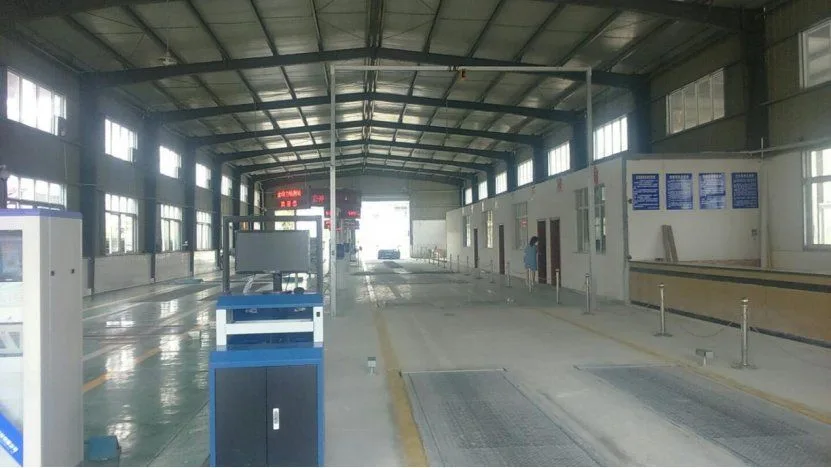
Indoor vehicle inspection lane with test benches and control console
The advantages are repeatability, environmental stability, and throughput. The obligations are civil works and utilities: a level reinforced pit with drainage and signal conduits, three-phase AC 380 V supply, and compressed air at the rated pressure for pneumatic lifting. Facilities should also plan for calibration access and for drainage that keeps moisture away from load cells.
Containerized and Mobile Test Lanes
Mobile lanes package core benches into a transportable frame—sometimes a container—so inspection capability can be deployed to a fleet depot, a remote region, or a temporary site. Cartesykj's mobile range includes car-and-truck stations (CTYJ-10), car-only stations (CTMBGT-3-4P), motorcycle stations, and combined three-in-one and four-in-one configurations. The key decision is functional scope. A mobile unit built around a brake tester and axle load measurement can deliver a meaningful safety screen, while adding suspension, side-slip, and speedometer modules increases both capability and setup time. Check whether the platform needs an external air supply, what leveling tolerance the site must provide, and whether local regulations accept mobile-lane results for the inspection category in question.
Remote Sensing Devices (RSD) for Roadside Testing
Remote sensing devices measure vehicle emissions as a vehicle passes a roadside optical and gas-sensing path, without stopping it. RSD is a screening tool for high-emitting vehicles and fleet profiling; it does not replace lane-based brake, suspension, or speedometer testing, and it cannot produce the axle-by-axle measurements that a statutory roadworthiness inspection requires. This distinction belongs in any equipment plan. Cartesykj's product focus is lane-based and mobile-station testing, together with mobile-source instruments such as five-parameter comprehensive testers that support roadside emission work. Facilities considering RSD should treat it as a complementary screening layer and confirm separately whether the local authority accepts remote-sensing results as evidence, how measurements are calibrated, and which vehicle categories the method covers. Specifying RSD as a substitute for a physical inspection lane is a category error that leads to failed audits.
How to Choose the Right Vehicle Inspection Equipment
Ensuring Regulatory Compliance and Certification
Start with the acceptance standard, not the machine. A suspension tester that follows EUSAMA methodology and meets JT/T448-2001 for suspension test benches gives a documented basis for absorption-rate decisions; a brake tester with <1.5% force error sits comfortably inside a 3.0% national tolerance. Ask which standard each function is type-approved against, and request the certification pack rather than accepting a verbal claim. Cartesykj's production systems and component lines operate under ISO9001 quality management certification and carry CE certification. Verification should go further: confirm calibration certificates for load cells and force transducers, request the factory inspection record, and check that the software's pass/fail thresholds can be configured to the local mandate. Where a function is not covered by local regulation, say so explicitly in the lane design rather than implying certification.
Compatibility Across Diverse Vehicle Models
Map the actual fleet before selecting models. Three parameters drive compatibility:
- Axle rating — match the heaviest projected axle load to the equipment class, distinguishing drive-over capacity from active test load.
- Wheel track envelope — confirm both minimum inner and maximum outer track. A 700 mm inner limit is required for narrow vehicles; outer spans from 2,400 mm to 2,900 mm determine whether wide commercial axles fit.
- Site geometry and utilities — pit depth and footprint, three-phase 380 V supply, air pressure (0.5–0.6 MPa light duty; 0.7–0.8 MPa heavy duty), drainage, and cable conduits.
A 3,000 kg brake tester deployed on a mixed commercial lane risks structural overload; a 15,000 kg bench on a passenger-car-only site raises excavation cost without adding useful capability. Compatibility also means software: results from brake, suspension, side-slip, and speedometer benches should arrive in one report format so the lane can be sequenced without manual re-entry.
Evaluating Technical Support, Software, and Spare Parts
Capital price is only one part of total ownership cost. Roller coatings, hydraulic seals, high-pressure lines, slide bearings, airbag lifts, and load cells all wear and all affect measurement accuracy when they degrade. A roller surface bonding rated beyond 200,000 test cycles with adhesion above 0.85 in wet and dry conditions is a materially different proposition from a plain knurled roller that loses grip when wet. Request the following before purchase:
- Spare parts list and dispatch times for wear items, with confirmation that motors and hydraulic valving use serviceable industrial standards.
- Calibration procedure and interval for each measuring function, including who can perform it and what fixtures are required.
- Software support scope — lane sequencing, data export format, report customization, threshold configuration, and update policy.
- Response commitment — telephone and on-site response times, service network locations, and resident engineer availability.
- Training coverage — operation, daily maintenance, and common fault diagnosis for the play detector, brake bench, and other core stations.
Facilities should also institute an operating checklist: clear roller surfaces and pit debris daily, verify slip-detection sensors, check pedal-force and load-cell calibration at planned intervals, inspect airbag pressure, and monitor reducer lubrication. These routines preserve sub-1.5% brake accuracy and ≤2% suspension repeatability over the equipment's service life.
Frequently Asked Questions
What core instruments make up a vehicle inspection equipment lane? A statutory lane normally combines a brake tester, axle load measurement, sideslip tester, suspension tester, speedometer tester, emissions and smoke analyzers, headlight tester, and a lane control system. A play detector is added where chassis clearance inspection is required. Can a sideslip tester replace four-wheel alignment equipment? No. It measures net dynamic lateral scrub as the vehicle crosses a floating plate and flags geometry faults quickly. It does not report isolated caster, camber, kingpin inclination, or tie-rod adjustment values; defective vehicles must go to an alignment workshop. How do I choose between a 3,000 kg and 15,000 kg brake tester? Base the decision on the heaviest axle the lane will measure. CTFZ-3B covers 3,000 kg passenger applications, CTFZ-10B covers 10,000 kg commercial fleets, and CTFZ-13B covers 15,000 kg heavy freight and buses. Also check outer wheel track—up to 2,900 mm on the heavy model. What does a suspension tester actually measure? It oscillates the wheel at ≥23 Hz, cuts motor power, and records the minimum dynamic vertical force as resonance decays. Absorption rate is minimum dynamic wheel load divided by static wheel load. It follows EUSAMA methodology and JT/T448-2001 on Cartesykj CTXX platforms. What can a play detector reveal that other benches cannot? It applies loaded fore/aft and lateral plate movement so an inspector can see clearance in tie rods, ball joints, steering arms, wheel bearings, and suspension bushings while the vehicle weight is on the contact patches, without dismantling assemblies. Does a speedometer tester measure engine power? No. It is a non-absorptive roller bench that compares dashboard indication with roller surface speed from 0 to 130 km/h. Engine power and road-load simulation belong to a chassis dynamometer, which is a different category of vehicle inspection equipment. Are mobile test lanes accepted for official annual inspection? It depends on the local authority and inspection category. Mobile stations offer deployment flexibility but lower environmental control and throughput. Confirm regulatory acceptance before treating a mobile lane as a replacement for a fixed station. Do these benches require floor anchoring? Cartesykj's welded high-strength frames for the brake, suspension, and speedometer series do not require ground anchor bolts. A level reinforced pit with drainage and conduits is still required; civil drawings should follow the confirmed model footprint.
Engineering Consultation and Quotation
Selecting vehicle inspection equipment is an exercise in matching measured capabilities to a real fleet, a real pit, and a real regulatory mandate. A brake tester with documented sub-1.5% accuracy, a suspension tester reporting repeatability within ≤2%, a sideslip tester with the correct plate kinematics, a play detector rated for the right axle class, and a speedometer tester covering the required speed range form a lane that produces defensible results cycle after cycle. Cartesykj supplies these core benches for light vehicle, heavy-duty, and motorcycle applications, in fixed and mobile configurations, with documented ISO9001 and CE production credentials. Send us your vehicle categories, axle-load range, wheel track data, pit dimensions, and daily throughput target. Our engineering team will return a configuration proposal, foundation drawings, and a formal quotation—including what each function can and cannot certify in your jurisdiction.