
Insights
Electric Vehicle Testing Equipment: EVSE, Battery & Safety Guide
Choose the right electric vehicle testing equipment: EVSE analyzers, battery test systems, insulation tools and safety ratings for lab and field work.
Charging site commissioning, battery validation and roadside repair all come down to the same question: can you trust the measurement in front of you? This guide shows which electric vehicle testing equipment matters for each job, what capabilities to insist on, and how to specify a setup without overspending.
Table of Contents
- Overview of Electric Vehicle Testing Equipment
- Key Features and Technical Capabilities
- Essential Types of EV Testing Equipment
- Primary Application Scenarios
- How to Choose the Right EV Testing Equipment
- Frequently Asked Questions About EV Testing Tools
Key Takeaways
- Match the tool to the job: EVSE analyzers prove chargers, battery test systems prove cells and packs, handheld tools prove a vehicle is safe to touch.
- High-voltage work demands rated instruments and probes, not just a high voltage range on the display.
- Connector shape is not compatibility — the tester must also speak the charging protocol (CCS1, Type 2/CCS2, NACS).
- Field kits prioritize portability and battery power; lab systems prioritize channels, repeatability and environmental control.
- Calibration support and firmware updates belong in the purchase decision, not an afterthought.
Overview of Electric Vehicle Testing Equipment
Electric vehicle testing equipment covers three distinct jobs: proving a charger delivers safe power, proving a battery behaves as designed, and proving a vehicle is safe to service. The tools overlap in purpose but not in method, and buying the wrong category is the most common way to waste a budget.
What is EV and EVSE Testing Equipment?
EV testing equipment is the instrument family used on the vehicle side: battery packs, high-voltage cabling, inverters, contactors and onboard chargers. EVSE testing equipment targets the other end of the cable. EVSE stands for Electric Vehicle Supply Equipment — the charger, its connector, its control circuitry and its grid connection.
In practice, a single workflow uses both. An EVSE analyzer checks whether the charger presents a valid control pilot signal, delivers the advertised current and shuts down safely on fault. A vehicle-side insulation test then confirms the vehicle accepts that power without a leakage path to ground. Suppliers marketing New Energy Vehicle Inspection Equipment usually bundle both sides because commissioning and service teams rarely work on just one.
The Role of Testing in eMobility Safety and Performance
Testing is what makes high-voltage systems serviceable. A modern pack typically sits around 400 V, with 800 V architectures increasingly common in newer platforms — levels where a tool that is merely "rated for 300 V" is simply the wrong instrument.
Three outcomes depend on reliable test data. First, technician safety: insulation and continuity checks establish whether a vehicle can be opened at all. Second, interoperability: a charger can look correct and still fail to handshake with a specific vehicle. Third, product quality: battery formation and end-of-line tests catch weak cells before they reach a customer. ev safety inspection equipment is the category name most often used for the first and third of these jobs.
The voltage you are working on determines the instrument class. The table below shows the two platform families most service tools must cover:
| Battery platform | Nominal pack voltage | Typical operating window | Test implication |
|---|---|---|---|
| 400 V class | about 350–450 V | roughly 250–500 V | Insulation test voltage commonly set above the pack maximum |
| 800 V class | about 550–800 V | roughly 400–950 V | Needs probes and meters rated to the higher category and voltage |
These are representative ranges drawn from public manufacturer data, not a specification for any one vehicle. Always read the actual nameplate and service manual before selecting a test voltage.
Core Testing Standards and Compliance Requirements
Most equipment decisions trace back to a small set of standard families:
| Standard family | What it governs | Why it affects your purchase |
|---|---|---|
| IEC 61851 | Conductive charging system behavior and control pilot signaling | Analyzer must generate and read the pilot states correctly |
| IEC 62196 | Connector and inlet dimensions and pin assignments | Adapters must exist for the connector types you service |
| ISO 15118 | Vehicle-to-charger communication, including Plug & Charge | Protocol simulators need current firmware |
| SAE J1772 / SAE J3400 | North American AC connector and the NACS standard | Test leads must match the vehicles in your market |
| IEC 61010-1 | Safety requirements for measurement equipment | Defines the measurement category (CAT) ratings you should demand |
Standards are revised, and regional adoption differs. Confirm the current edition with the issuing body before writing a purchase specification, and ask a prospective Vehicle Inspection Equipment Supplier which editions their firmware supports.
Key Features and Technical Capabilities
The spec sheet that matters is not the longest one. Four capabilities separate equipment that produces defensible results from equipment that produces numbers.
High-Voltage Insulation and Safety Diagnostics
Insulation testing applies a DC test voltage above the system's normal operating voltage and measures resistance to ground. The point is not to obtain an impressive megaohm figure; it is to detect a degraded cable, a moisture path or a failed barrier before energization. Pair the insulation tester with the manufacturer's specified test voltage and disconnect sensitive electronics first.
Measurement category is non-negotiable. Look for instruments and leads rated CAT III 1000 V or CAT IV 600 V for high-voltage EV work, with probes rated to the same category. A multimeter with a high voltage display but a lower category rating is not equivalent. Lockout/tagout, rated gloves and an approved discharge procedure still apply — the instrument does not replace the procedure.
Measurement categories describe where a tool may be used, not just how much voltage it can read. Use this table as a starting point when checking a specification:
| Category | Intended circuit | Typical EV application | What the rating means |
|---|---|---|---|
| CAT II | Appliances, wall outlets | AC inlet at the charger, low-voltage vehicle systems | Transient protection for single-phase loads |
| CAT III | Fixed wiring, distribution | HV battery junction box, inverter, DC charging output | Protection for distribution-level transients |
| CAT IV | Service entrance, outdoors | Upstream supply to the charging site | Highest transient protection class |
A tool rated for a higher category may be used in a lower one, provided its voltage rating also fits. Verify exact limits against IEC 61010-1 and the manufacturer's printed marking.
High-Resolution Signal Measurement and Oscilloscopes
Charging faults are often communication faults. The control pilot carries a PWM signal whose duty cycle communicates the charger's current limit, and ISO 15118 systems layer power-line communication on the same line. An oscilloscope lets you see a missing PWM edge, a stuck pilot state or noise coupling into a CAN line — failures a simple continuity test will never reveal.
A 100 MHz oscilloscope with adequate differential probes is generally enough to inspect pilot PWM and low-speed bus traffic; higher bandwidth becomes useful when chasing switching noise. Pay attention to sample rate and vertical resolution, and use differential probes rated for the voltage present. Probing a pack directly with a standard grounded scope lead is a reliable way to destroy both the instrument and the measurement.
For quick checks, these are the control pilot duty-cycle values defined by IEC 61851-1 and the current limits they communicate. They make a useful sanity-check table when a charger reports an unexpected current:
| PWM duty cycle | Announced current limit | Calculation (duty × 0.6 A) |
|---|---|---|
| 10% | 6 A | 6.0 A |
| 13% | 8 A | 7.8 A |
| 16% | 10 A | 9.6 A |
| 32% | 20 A | 19.2 A |
| 50% | 30 A | 30.0 A |
| 85% | 51 A | 51.0 A |
These figures follow the IEC 61851-1 relationship for the 10–85% range. Values above 85% map to a different formula and to digital communication modes under newer editions. Confirm the applicable edition and rounding convention before using this table as a formal test criterion.
Rugged, Portable Design for Field vs. Lab Environments
Field equipment lives in a van, on a concrete pad and in weather. Prioritize battery operation, a protected casing, legible displays in daylight, stored test records and leads that survive repeated coiling. An ingress rating such as IP54 is a useful baseline for outdoor work, provided the manufacturer states it for the complete assembled kit.
Lab equipment lives on a bench and is judged differently: channel count, repeatability, software control, data export and integration with environmental chambers. Portability features add cost without adding value there. Decide the environment first, then filter features — the same instrument rarely excels at both.
Compatibility with Major Charging Standards (CCS1, Type 2, NACS)
Compatibility has two layers. The connector layer is visible: CCS1 in North America, Type 2 and CCS2 in Europe, NACS — standardized as SAE J3400 — across much of the North American fast-charging market, and CHAdeMO still present in older installs. The protocol layer is invisible and is where cheaper adapters fail.
Before buying, list the connector types and charging standards you actually encounter, then verify the tester supports both the physical interface and the signaling. Firmware upgradeability matters here: a unit that cannot be updated will drift out of step as vehicle and charger implementations evolve.
Use this comparison to identify which interfaces your fleet actually needs. Power figures are typical ranges seen in public deployments, not fixed limits of the connector itself:
| Interface | Primary region | Current type | Commonly seen power | Tester support to check |
|---|---|---|---|---|
| Type 1 / J1772 | North America | AC, single-phase | up to about 7–19 kW | Pilot PWM, proximity circuit |
| Type 2 / Mennekes | Europe | AC, single- or three-phase | about 11–22 kW | Pilot PWM, three-phase timing |
| CCS1 | North America | DC fast | about 50–350 kW | DC protocol, PLC communication |
| CCS2 | Europe | DC fast | about 50–350 kW | DC protocol, PLC communication |
| NACS (SAE J3400) | North America | AC and DC | about 11–250 kW | Both AC pilot and DC protocol |
| CHAdeMO | Japan, older global installs | DC fast | about 50–100 kW | CAN-based protocol |
Connector geometry alone does not tell you which protocol a tester supports. Confirm both columns against the equipment datasheet before purchase.
Essential Types of EV Testing Equipment
Four equipment groups cover nearly every workshop, commissioning team and battery lab. This table helps you locate which group answers which question:
| Equipment group | Primary question it answers | Typical user | Typical setting | Key output |
|---|---|---|---|---|
| EVSE analyzers and adapters | Does the charger deliver safe, correct power? | Commissioning and service teams | Field and site | Pass/fail commissioning record |
| Battery test lab systems | Does the cell or pack meet its design envelope? | R&D and manufacturing engineers | Laboratory | Cycle, capacity and thermal data |
| Handheld diagnostic tools | Is the vehicle safe to approach and what is failing? | Service technicians | Field and workshop | Spot readings, thermal images |
| Hybrid and EV test kits | Do I have the complete rated set for a job? | Workshops and training teams | Workshop and field | A traceable, matched tool set |
EV Charging Station (EVSE) Analyzers and Test Adapters
An EVSE analyzer emulates a vehicle and verifies that the charger responds correctly: pilot signal, grounding and protective conductor checks, voltage and current delivery, power measurement, error states and session termination. Test adapters extend the analyzer to different connectors and let you check an inlet without a vehicle present.
The output should be a commissioning record you can hand to a client: measured values, pass/fail criteria and a timestamp. That record is often the difference between a charger accepted at handover and one that generates callbacks.
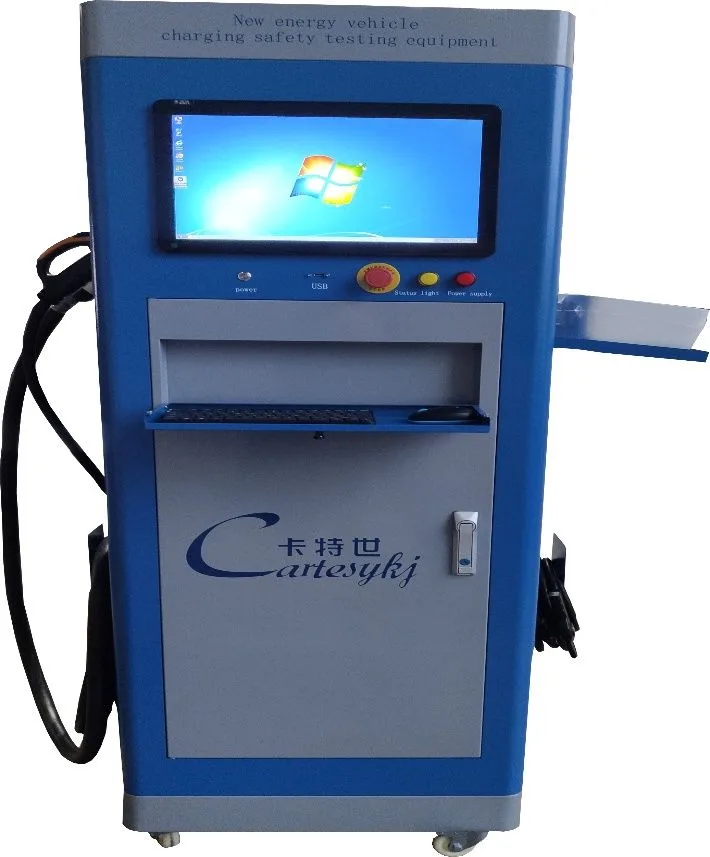
Cartesy new energy vehicle charging safety testing equipment.
EV Battery Test Lab Systems (Cyclers, Formation Systems, and Chambers)
Battery cyclers charge and discharge cells or packs under programmed profiles, measuring capacity, efficiency, internal resistance and life over repeated cycles. Formation systems perform the controlled first charges that establish cell performance in manufacturing. Environmental chambers add temperature control so teams can study behavior across the operating range.
Together these systems support New Energy Vehicle Safety Inspection at the development stage: verifying that a pack stays within its specified envelope under load, heat and repeated cycling. Lab results are only as good as the calibration of the channels, so log channel-level calibration dates alongside test data.
Handheld Diagnostic Tools (Insulation Multimeters, Clamp Meters, and Thermal Cameras)
Handheld tools are the first response kit for service work. Insulation multimeters establish whether a system is safe to approach. Clamp meters measure AC and DC current on cables without breaking the circuit. Thermal cameras reveal hot contacts, loose busbars and overloaded connections while the system is under load — defects that often look perfect in a resistance reading at rest.
A technician carrying these three tools can triage most field complaints before deciding whether a deeper diagnostic or a lab test is warranted. They are the core of any compact ev safety inspection equipment kit.
Comprehensive Hybrid and Electric Vehicle Test Kits
Kits bundle an instrument with matched leads, adapters, probes and a case. Their advantage is coherence: the insulated probes fit the meter, the adapters match the connectors in your region, and the set is documented as a single rated system. For teams onboarding technicians, a kit also shortens the time from training to productive work.
Check the contents against your actual fleet. A kit built around pure battery-electric vehicles may omit the tools a hybrid technician needs for its separate low-voltage and high-voltage domains.

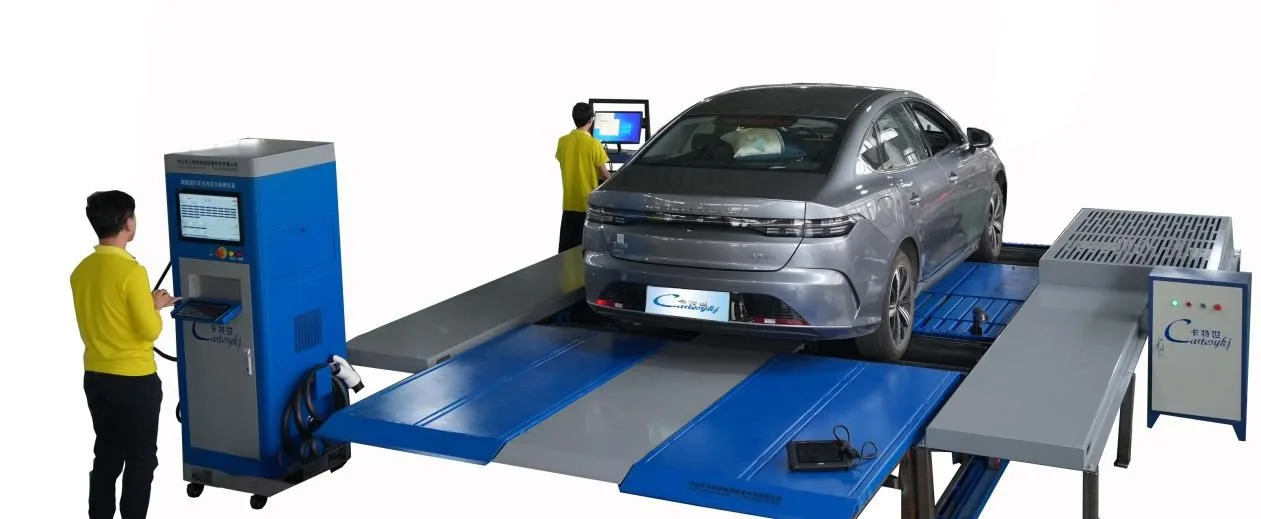
Chassis dynamometer platform for new energy vehicle inspection.
Primary Application Scenarios
The same instrument can serve several scenarios, but the sequence of work — and therefore the tool order — changes.
EV Charging Infrastructure Installation and Commissioning
Commissioning follows a logical order: visual and grounding inspection, insulation and protective conductor checks, control pilot and proximity pilot verification, communication test, then a controlled load test at the advertised current. Each stage has a pass/fail result, and later stages should not begin until earlier ones pass.
At handover, the installer needs evidence, not impressions. A logged analyzer report with measured pilot duty cycle, voltage, current and fault-state behavior gives the site owner a defensible record and gives the service team a baseline for future comparisons.
EV Battery Pack R&D and Manufacturing Validation
In R&D, cyclers and chambers answer design questions: how capacity fades with temperature, how quickly a pack recovers, where resistance grows. In production, the questions narrow to repeatability — does every pack leaving the line meet the same limits? Formation systems and end-of-line testers provide that gate.
The bridge between the two is data consistency. Use the same measurement definitions in development and production, or the production limits will not reflect what the design team actually validated.
Automotive Service, Maintenance, and Field Diagnostics
Service work is problem-led: a charging complaint, a warning lamp, a thermal event, a post-collision inspection. The technician starts with safety checks, moves to handheld diagnostics and code reading, and escalates to an EVSE analyzer or a specialized probe set only when the symptom points there.
Turnaround time drives tool selection in this scenario. A compact kit that covers 90% of visits is more valuable than a lab-grade system that stays in the workshop — provided the safety ratings are never compromised.

Chassis dynamometer and control cabinet in a vehicle inspection line.
How to Choose the Right EV Testing Equipment
Selection gets easier when you separate environment, electrical performance and commercial terms instead of comparing headline prices.
Assessing Lab vs. Field Service Testing Needs
Start with three questions. Where will the instrument be used — bench or site? What voltage and current ranges will you actually encounter? How many tests per day must it survive? Field users should optimize for portability, battery life and casing protection; labs should optimize for channel count, automation and data handling.
Write the answers down as a one-page requirement list before requesting quotes. It prevents a sales conversation from defining your specification.
Evaluating Measurement Resolution, Safety Ratings, and Cost
Resolution determines whether small changes are visible; accuracy determines whether the number can be trusted; safety rating determines whether the instrument may be used at all. Check all three, plus the rating of the leads and probes that ship with the unit.
Then look at total cost of ownership: calibration intervals and fees, replacement leads, software licenses, firmware updates and training. A lower purchase price can evaporate quickly if the probes are proprietary and the annual calibration is expensive. Because regional rules and accreditation requirements differ, verify applicable local obligations with the relevant authority rather than relying on a generic checklist.
Avoiding Common Purchasing Pitfalls in EV Diagnostics
Four mistakes recur in EV purchases:
- Connector-only thinking. An adapter that physically fits does not mean the tester supports that communication protocol.
- Ignoring measurement category. A high voltage range is not a substitute for a CAT III or CAT IV rating on both instrument and leads.
- Buying without a calibration path. If the manufacturer cannot issue a traceable certificate, the data may not be accepted by your client or accreditation body.
- Treating firmware as optional. Charging implementations change; a tester that cannot be updated becomes a static snapshot of yesterday's standards.
Ask any Vehicle Inspection Equipment Supplier for the current standard editions supported, the calibration certificate format and the firmware update policy — in writing, as part of the quote.
Frequently Asked Questions About EV Testing Tools
What Safety Ratings Are Required for High-Voltage EV Testing?
For high-voltage EV work, look for instruments and probes rated CAT III 1000 V or CAT IV 600 V to IEC 61010-1, and verify the rating printed on the leads as well as the meter. Exact requirements depend on the system, the location in the installation and local regulations, so confirm against the applicable rules and the vehicle or charger manufacturer's service documentation. A rated meter does not remove the need for insulated tools, PPE, lockout/tagout and a verified discharge procedure.
How Often Should EVSE and Battery Testing Equipment Be Calibrated?
An annual interval is common for test and measurement equipment, but the correct interval depends on the manufacturer's specification, your accreditation requirements and how hard the instrument is used. Calibrate sooner after a drop, repair, or any reading that looks inconsistent with a known reference. Keep the certificates with the equipment and record channel-level dates for multi-channel battery test systems.
Typical intervals reported across the industry are shown below. Treat them as a starting point, not a substitute for your own quality procedure:
| Equipment | Commonly cited interval | Trigger for earlier calibration |
|---|---|---|
| Handheld multimeters and clamp meters | 12 months | Drop, repair, out-of-range reading |
| Insulation testers | 12 months | Failed self-check, changed leads |
| EVSE analyzers | 12 months | Firmware update affecting measurements |
| Battery cyclers and channel electronics | 12 months or per-channel schedule | Channel drift, module replacement |
| Thermal cameras | 12 months | Image anomaly, detector service |
Summary
Reliable EV diagnostics come from matching the instrument to the job, then protecting the measurement with correct safety ratings, supported protocols and a calibration path. Start with your actual voltage ranges, connector types and test volume — those three answers eliminate most unsuitable equipment before you request a single quote.
Ready to specify your setup? Put those three numbers into the checklist above, shortlist two or three configurations, and ask each supplier to demonstrate the same test on the same vehicle or charger before you commit.